> For the complete documentation index, see [llms.txt](https://resources.viewrail.com/llms.txt). Markdown versions of documentation pages are available by appending `.md` to page URLs; this page is available as [Markdown](https://resources.viewrail.com/guides/planning/choose-the-right-railing-for-your-project/cable-railing-vs.-rod-railing-which-one-is-right-for-your-project.md).
# Cable Railing vs. Rod Railing: Which One Is Right for Your Project?
Cable and rod railing both offer sleek stainless steel style, but they differ in installation time, corrosion resistance, and curved applications. Here's how to choose.
Both cable railing and rod railing bring a clean, modern look to decks, stairs, and balconies. They share a lot in common: slim stainless steel profiles, hidden hardware, and a contemporary aesthetic that works inside and out. But when you dig into the details, these two systems are meaningfully different.
{% columns %}
{% column %}
**Cable railing**
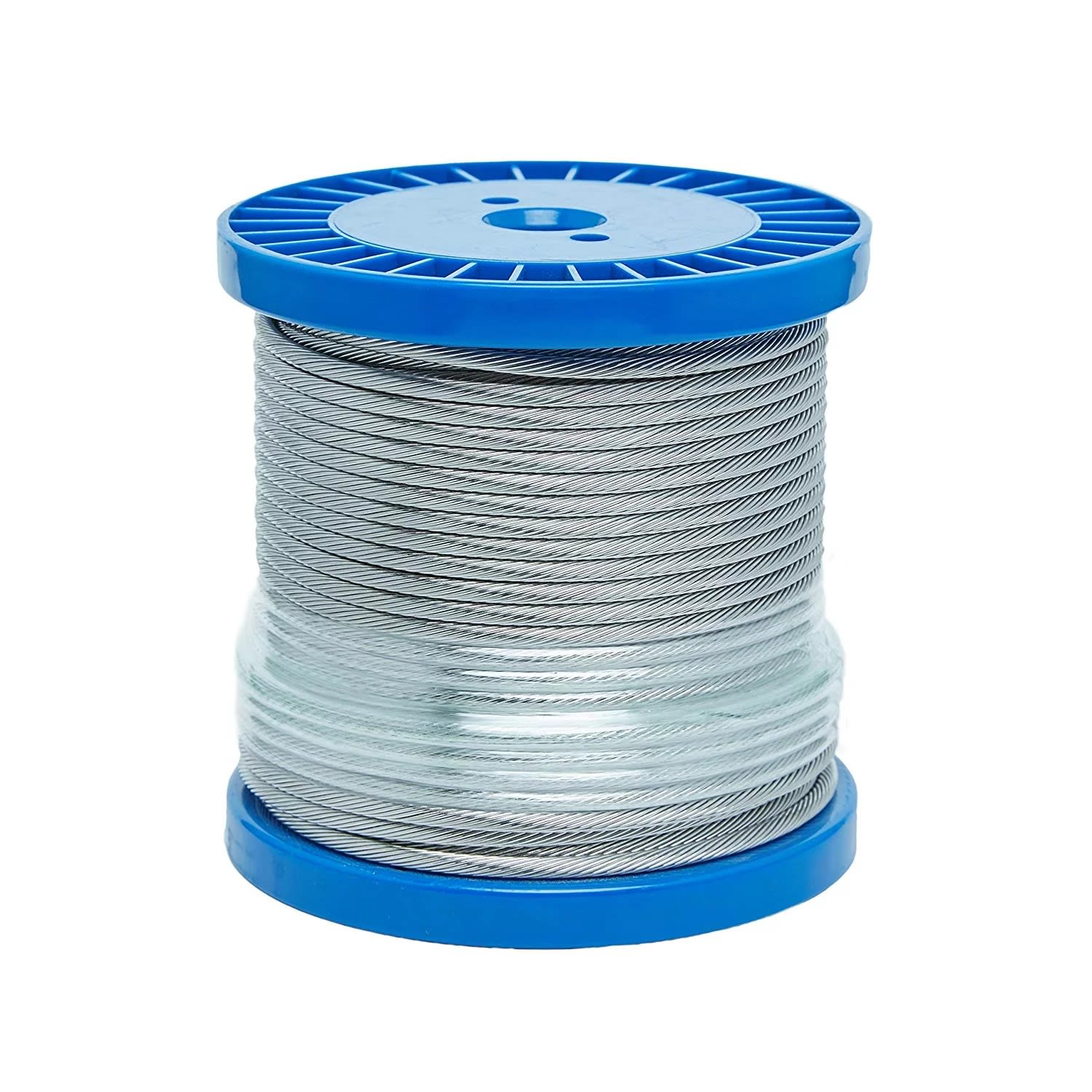
Uses woven stainless steel cable with the lightest visual line.
{% endcolumn %}
{% column %}
**Rod railing**
Uses solid stainless steel rod with a slightly bolder profile.
{% endcolumn %}
{% endcolumns %}
Here's what you need to know before you choose.
### How They Compare at a Glance
| | Rod Railing | Cable Railing |
| -------------------------- | --------------------------- | ------------------------- |
| **Infill diameter** | 1/4" | 5/32" |
| **Material** | 2205 Duplex Stainless Steel | 316L Stainless Steel |
| **Installation time** | \~30–40 min/post | \~1 hr/post |
| **Curved applications** | Yes (min. 8' radius) | No — runs straight only |
| **Re-tensioning required** | No | Periodically |
| **Maintenance** | Wipe down as needed | Regular cleaning required |
| **Hidden hardware** | Yes | Yes |
### Installation: Rod Wins on Speed
Cable railing installation is familiar to most contractors, but don't let its simple appearance fool you, it takes time. Because cable comes on spools, it naturally wants to curl back into a coil, which makes measuring and cutting tricky. You'll spend a surprising amount of time just working with the material itself. Plan on roughly **one hour per post** for cable.
Rod railing installs faster. The posts and handrails go in the same way as cable, so that part of the process is identical. The difference is in handling the infill. Rods ship straight, so measuring is easy. Cutting is clean and quick with an angle grinder and a thin cutting wheel. Expect around **30–40 minutes per post** for rod.
For a large project, that time difference adds up quickly.
### Corrosion Resistance: Rod Is the Stronger Choice Coastal
Both systems use stainless steel, but not the same alloy, which makes a big difference in harsh environments.
**Cable railing** uses **316L stainless steel**, which has been the industry standard for corrosion resistance in architectural railing for decades. It holds up well in most environments, but it has limits near saltwater.
**Rod railing** uses **2205 duplex stainless steel**, a material with a long track record in some of the world's most demanding environments, including deep-sea oil drilling infrastructure. The way the industry measures corrosion resistance is through a Pitting Resistance Equivalency Number (PREN). For an alloy to hold up in oceanside conditions, it needs to score at least 32. 2205 scores 34. 316L scores 25, well below that threshold.
If your project is near the coast or in another high-humidity, high-salt environment, rod railing is the more reliable long-term choice.
### Maintenance: Both Are Low-Effort, But Not Zero-Effort
Neither system requires much ongoing maintenance, but they're not identical.
**Cable railing** is made up of 19 individual wires twisted together into a single strand (called a 1×19 construction). That woven structure creates small gaps where salt, moisture, and debris can collect if the cable isn't cleaned regularly. Over time, built-up contaminants can accelerate corrosion and, in the worst cases, cause the individual wires to begin separating. Regular cleaning keeps this from becoming a problem.
**Rod railing** is a single, solid tube with a smooth, continuous surface. There are no gaps for contaminants to settle into. That said, you should still keep an eye on the points where rods pass through posts — debris can collect in those holes and cause staining over time.
For both systems, a microfiber cloth and mild soapy water is all you need for routine cleaning.
### Curved Applications: Only Rod Can Follow a Radius
If any part of your railing follows a curve, a rounded deck edge, a sweeping balcony, a spiral-adjacent staircase, this is one of the most important factors in your decision.
**Cable railing always runs in a straight line.** Once tensioned, cable travels directly from post to post. There's no way to create a true curve or radius with cable.
**Rod railing can be bent** to follow curves as tight as an 8-foot radius. If your project has any curved sections, rod is your only option between these two systems.
### Which One Should You Choose?
Both systems are excellent choices for modern, open-look railing. Here's a quick way to frame the decision:
* **Choose cable** if your project is in a standard (non-coastal) environment, your layout is all straight runs, and you're comfortable with the installation process.
* **Choose rod** if you're near the coast, have curved sections in your railing, want the fastest installation, or prefer a virtually maintenance-free infill that won't need re-tensioning.
Either way, both systems offer the clean sight lines and hidden hardware that define modern railing design.
### Related topics
#### Compare related railing options
* [What is Cable Railing?](/guides/about-stairs-and-railing/what-is-cable-railing.md) — Review how cable systems work, where they fit, and what they cost.
* [What Railing Should I Choose for My Stairs?](/guides/planning/choose-the-right-railing-for-your-project/what-railing-should-i-choose-for-my-stairs.md) — Compare cable, rod, and glass for stair projects.
* [Choose Your Signature Infill](/guides/planning/how-can-i-customize-my-cable-railing/choose-your-signature-infill.md) — Compare stainless cable, stainless rod, and Onyx Rod.
#### Plan for environment and upkeep
* [Why 2205 Stainless Steel Is the Gold Standard for Coastal Railing](/guides/about-stairs-and-railing/railing-system-deep-dives/why-2205-stainless-steel-is-the-gold-standard-for-coastal-railing.md) — See why 2205 outperforms 316L near saltwater.
* [How Do I Maintain Cable Railing?](/guides/maintenance/how-do-i-maintain-cable-railing.md) — Learn cleaning and re-tensioning expectations for cable.
* [How Can I Customize My Cable Railing?](/guides/planning/how-can-i-customize-my-cable-railing.md) — Explore post styles, finishes, and handrail options.
---
# Agent Instructions
This documentation is published with GitBook. GitBook is the documentation platform designed so that both humans and AI agents can read, navigate, and reason over technical content effectively. Learn more at gitbook.com.
## Querying This Documentation
If you need additional information that is not directly available in this page, you can query the documentation by asking a question.
Perform an HTTP GET request on the following URL with the `ask` and `goal` query parameters:
```
GET https://resources.viewrail.com/guides/planning/choose-the-right-railing-for-your-project/cable-railing-vs.-rod-railing-which-one-is-right-for-your-project.md?ask=&goal=
```
`ask` is the immediate question: it should be specific, self-contained, and written in natural language.
`goal` is what the user is ultimately trying to achieve, the reason they need the answer. Sharing it helps GitBook give you a better, more relevant answer. A goal is most helpful when it describes the outcome the user wants rather than restating the question. For example, with `ask=how do I create an API token`, a goal like `automate deployments from our CI pipeline` lets GitBook tailor the answer to that use case.
The response will contain a direct answer to the question and relevant excerpts and sources from the documentation.
Use this mechanism when the answer is not explicitly present in the current page, you need clarification or additional context, or you want to retrieve related documentation sections.